|
“Each January is a fresh start. You know that this year, at long last, your garden is going to be perfect: cascades of never-ending bloom, each plant superbly placed and superbly grown, no weeds, no bugs, no bare spots, no mistakes. And, of course, no maintenance.”
– Josephine Nuese, 1901-1974, American gardener and author of The Country Garden, 1970.
|
Dahlias - Some Old Ones and Some New Ones are Ready to Order
|
|
|
While some of the dahlias are waiting to be divided, we have some new beauties to view and more to come. If you have already ordered some dahlias, these can be added to your order. If you’re adding at least $30 worth of bulbs, you can simply place a new order and tell us in the Special Requests box of our order form to combine your orders. To add less than $30 worth, please call us at (734) 995-1486 or email help@oldhousegardens.com.
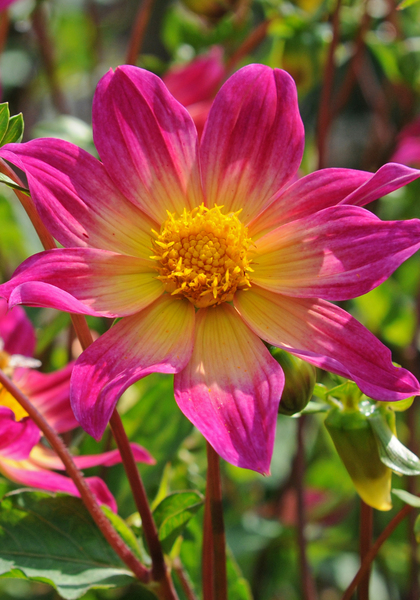
Bees and butterflies are drawn to the bright, airy blooms of this single-flowered dahlia — and gardeners will be too. The bright petals glow from fuchsia-pink to yellow at the base, surrounding a yellow eye. “Bright Eyes” responds beautifully to regular deadheading, producing an abundance of 2-4” blooms that appear to float gracefully atop swaying stems, bringing lasting cheer to borders. Originally hybridized by Joy Gill of Coquille, OR in 1981. Single, 2-3’, from Holland.
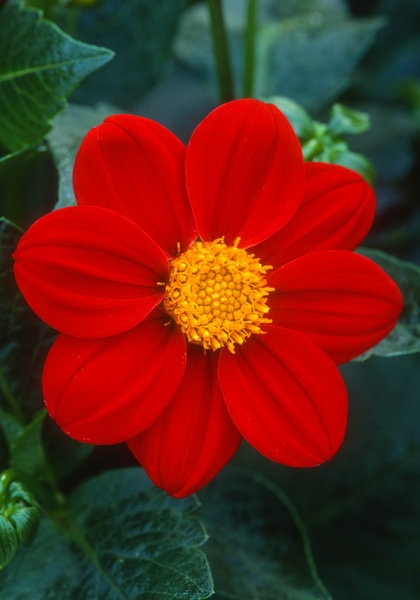
Like the mythical bird, this single-flowered dahlia is a fiery red flower with a yellow eye, invoking an image of fire. Not to be confused with the semi-cactus type dahlia, Vuurvogel, which is Dutch for Firebird. Both are credited to Dutch dahlia breeder D. Bruidegom. The bold, fiery 2-4” flowers bloom on short sturdy stems, which make them a favorite for bees and gardeners alike. Single, 20-24”, from Holland.
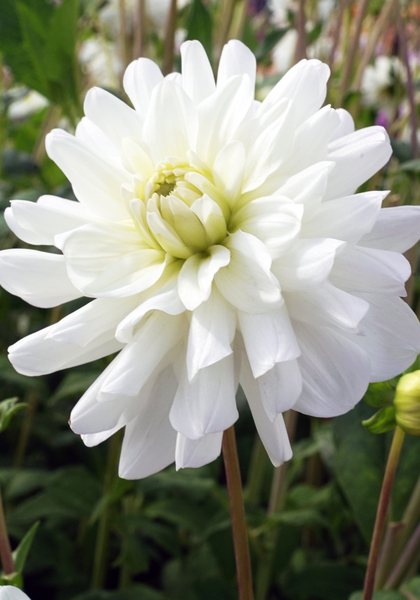
This variety has elegant blooms with pure white petals that become flushed with pink as they age and a center that is touched with yellow. Dahlia “Le Castel” is an RHS Garden Merit award-winning variety from French hybridizer Louis Laurent and grown every year in Crevant at the Dahlia Park as a gift from Laurent. (Link here). Its Camelia to Waterlily formed flowers of 4-6” and long stems make it an excellent cut flower. Waterlily/Camelia, 3-4’, from Holland.
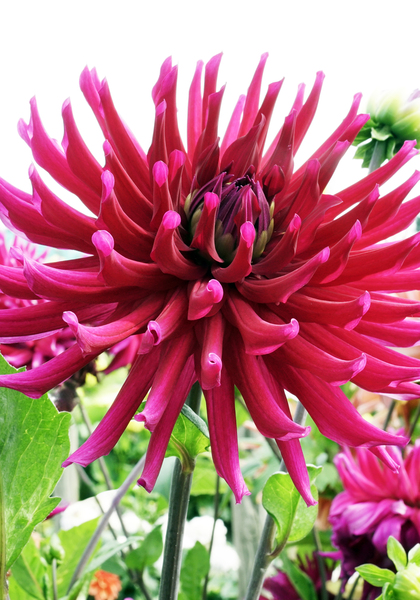
The long, spiky, quill-like petals of this cactus-type dahlia bring drama to the garden. Its hues are reminiscent of crushed berries with highlights of fuchsia. The versatile flowers provide an almost iridescent quality in the garden or in a bouquet. This dynamic beauty was created in Holland and has been popular for over 70 years. Cactus, 40”, from Holland.
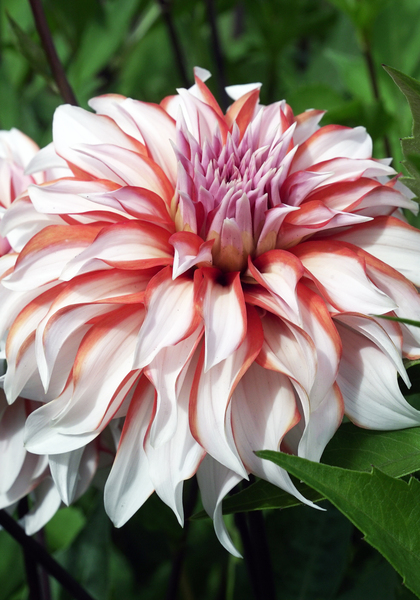
This informal decorative style dahlia brings an air of festivity to gardens and bouquets. It is 4-6 inches of ruffled petals with varying amounts of red and white on each bloom - no two flowers are the same. Hybridized by Harold Miller in the Pacific Northwest in 1983, who also authored “Dahlias: A Monthly Guide” and “Dahlias of Today.” Decorative, 40-50”, from Holland.
Pale creamy-yellow petals with pale pink tips are quilled, with its spikes making the flowers seem to shoot from their foliage like stars. From Henri Plochaet in Belgium, this flowery dahlia blooms on strong stems that work well in bouquets. Semi-cactus, 35-50”, from Holland.
|
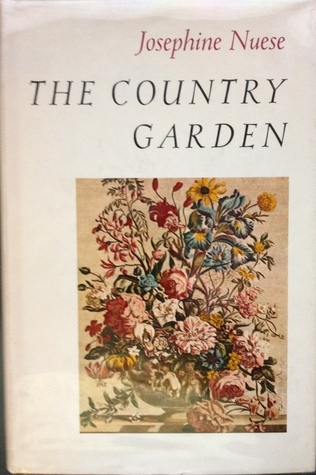
Josephine Nuese, a Lost Lady of Garden Writing
|
|
|
An annual garden quote from Josephine Nuese from her one and only book, The Country Garden (1970), precedes the quote that begins this month’s newsletter. “Anyone who thinks that gardening begins in the spring and ends in the fall is missing the best part of the whole year. For gardening begins in January, begins with the dream.”
Nuese goes on to describe January as the “gardener’s cocktail hour” - all plants are “enchanting.” The Country Garden has a chapter for each month and reading a chapter about gardening at the beginning of each month sounds like a great New Year’s resolution to me. I look forward to reading about seeds in February.
A quick search for information about Josephine led me to an article, “The Lost Ladies of Garden Writing” by Carol Michel. Michel’s research on Josephine Nuese reveals that, after working at Harper’s Bazaar, Vogue, then the New Yorker, she moved to northwestern Connecticut, gardened in a rural setting, and wrote an informal garden column for a local weekly paper. After a brief professional gardening career, she decided it took too much time from her private life and her own garden.
Carol Michel’s indexed list of 60 women she has researched can be found at here. When she finds a book or learns about a female garden writer, she researches the person and writes an article about them. The list took me down a rabbit hole of many interesting stories about authors and their writing. More stories of gardeners are likely to come in future months.
|
The Gift of Light for Daffodils
|
|
|
|
Greg Grant of Greg Grant Gardens and friend of OHG reminds us in a recent article that “daffodils are native to sunny meadows in Europe and will stop blooming if they do not get enough winter and early spring sunlight to store critical energy for the next year’s bloom.”
Greg visited Mrs. Lee’s Daffodil Garden in Gladewater, Texas about forty years ago. The garden is a nonprofit seasonal drive-through garden in Eastern Texas with areas to park, walk, and picnic. Greg had noticed back then that the canopy was closing and allowing less light to get to the daffodils. The gradual change from open woodland to a closed canopy forest is called mesophication. Shade loving trees and understory plants fill in, block the sunlight to the ground, causing those plants that like sunny meadows and open conditions to disappear.
At Mrs. Lee’s they have recently been working on thinning the trees and opening the canopy to restore the natural balance of the land. This restoration will help the millions of daffodils on the thousand-acre property thrive. The work will bring back the meadow grasses and wildflowers and improve the health of the pine, oak, and hickory trees to support birds, bees, and pollinators.
Mrs. Lee’s Daffodil Garden sounds like an incredibly beautiful, peaceful place in the spring. In Texas, daffodils tend to bloom in late February and early March. For seasonal updates, you can follow their progress on Facebook at The New Mrs. Lee’s Daffodil Garden.
This article was posted around the time I was planting daffodils on a hill in front of my house. The house was named Woodlawn by its original owner back in 1861 and we have always thought it was appropriately named because there are many mature trees shading the property - some over 100 years old. We have had an arborist managing the canopy and the trees look healthier, but has it been enough for my daffodils to thrive?
The trimmers spent a day in November removing a large branch of a Sugar Maple that had died. It was a significant portion of the tree and I was worried that the tree would not look right or the garden would be impacted by the loss of its shade. Reading about the importance of thinning the canopy did make me feel better. The tree looks much lighter with its remaining branches soaring straight up into the sky and the daffodils will get more sunlight. We are looking forward to a beautiful display of daffodils and a tree full of healthy leaves this spring!
The full article, “Keeping Mrs. Lee’s Daffodils Blooming,” can be seen at here.
Greg Grant is an award-winning professional horticulturist, author, photographer, and land steward with a Bachelor's Degree in Floriculture, a Master's Degree in Horticulture, and a Ph.D. in Forestry. He can be followed on Facebook at Greg Grant Gardens
For seasonal updates, you can follow the progress of the daffodils on Facebook at The New Mrs. Lee’s Daffodil Garden.
|
To Make Sure Our Newsletter Reaches You Safely . . .
|
|
|
Please add newsletter@oldhousegardens.com to your email address book or safe/approved list today.
|
To Unsubscribe
|
|
|
We hope you enjoy our monthly Gazette, but if not UNSUBSCRIBE here and we’ll drop you from our list immediately.
|
|